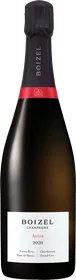
Boizel in Épernay: a family, partner growers and a cellar devoted to freshness
Six generations at 46 Avenue de Champagne
Founded in 1834 by Auguste Boizel, the house has always been based on the Avenue de Champagne in Épernay, one of the two capitals of Champagne, along with Reims. Passed down in a direct line, it has been run since 2018 by Florent and Lionel Roques-Boizel, the sixth generation, who also craft the blends as cellar masters [TO BE VALIDATED: 2018 according to The Drinks Business, 2019 according to Gault&Millau].
In 1994, the Boizel family sold a majority of its capital in exchange for a stake in the group that has since become Lanson-BCC, where the B stands for Boizel. Management of the house has remained in family hands. In 2024, Boizel produced around 500,000 bottles a year, half of them sold in France.
Seven hectares of its own, eighty with partner growers
Maison Boizel owns 7 hectares, in the Côte des Blancs and the Marne Valley. Most of its grapes come from partner growers, across roughly 80 hectares within a 30-kilometre radius of Épernay. Each grape variety has its own area: Chardonnay comes from the Côte des Blancs, Pinot Noir from the Montagne de Reims and Meunier from the Marne Valley.
Florent Roques-Boizel personally oversees these relationships with growers, which often go back several generations. In his view, access to the best grapes is now more fiercely contested than export markets.
A renovated cellar for tension
Boizel's winery, renovated for the 2017 harvest, was fitted with small stainless steel tanks, barrels and large oak foudres. Why renovate if the style is not changing? To preserve the freshness and tension of the wines as the climate warms, explains the house.
At Boizel, only the first juices from the pressing are retained, and all the wines undergo malolactic fermentation. Dosage levels have come down: in 2024, no cuvée exceeded 7 g/l, and most were extra bruts dosed at 3 to 5 g/l.
The house's chalk cellars, at 11 °C, slow the secondary fermentation, and all the wines rest there for at least three years on the lees. "Great terroirs need time to express themselves," sums up Florent Roques-Boizel.
Choosing a Boizel Champagne: non-vintage, cuvées of origin, single-village and vintage
Three non-vintage cuvées to enter the range
Boizel's three non-vintage cuvées form the first price tier, and the pursuit of freshness can already be tasted in them. The Brut Réserve is the house's benchmark brut, dominated by Pinot Noir; 5% of its wines are aged in foudre, for roundness of texture rather than for any taste of wood. The Rosé Absolu is a blended rosé, coloured with red wine from Les Riceys, in the south of Champagne, with the same contribution from foudre.
Boizel's Ultime Zéro Dosage, created in 2008, is a brut nature: no liqueur is added after disgorgement. Made from half Pinot Noir, completed with Chardonnay and a little Meunier, it spends at least five years on the lees, a length of time that gives it its creamy mousse and a balance that no sugar needs to correct.
La Côte and La Montagne, names that point to an origin
The La Côte and La Montagne cuvées are the house's former blanc de blancs and blanc de noirs, renamed to say where they come from. La Côte Blanc de Blancs Premier Cru is a pure Chardonnay from the Côte des Blancs, drawn mainly from Chouilly, Le Mesnil-sur-Oger, Avize and Vertus. La Montagne Blanc de Noirs is a pure Pinot Noir from Cumières, Mailly and Chigny-les-Roses.
Both cuvées remain blends of several villages, as Boizel considers blending to be the heart of the Champagne craft. La Côte appeals to lovers of fine, chalky blanc de blancs, La Montagne to those seeking the ripe fruit and brioche of Pinot Noir.
Avize or Tours-sur-Marne: the single-village cuvées
Boizel's single-village cuvées take the opposite approach: one village, one grape variety. Launched in 2025, the collection was joined in 2026 by two grands crus from the 2020 vintage, both aged five years on the lees.
Avize Blanc de Blancs Grand Cru comes from a village where the family has part of its roots and still cultivates several parcels. Tours-sur-Marne Blanc de Noirs Grand Cru lies at the junction of the Montagne de Reims and the Marne Valley, on clay-limestone soils rich in chalk. Avize focuses on chalk and salinity, Tours-sur-Marne on the generosity of Pinot Noir, between cherry and redcurrant.
Grand Vintage and Joyau, the two vintage cuvées
Grand Vintage and Joyau form the top tier of the Boizel range. Grand Vintage is the house's vintage extra brut, a blend of Pinot Noir and Chardonnay; the 2015 spent eight years on the lees. Joyau has been the prestige cuvée since 1961, under the name Joyau de France up to the 2008 vintage, whose first bottles still bear the old name.
Joyau comes exclusively from grands and premiers crus: for the 2013, Mailly, Chigny-les-Roses and Aÿ for Pinot Noir, Avize, Oger and Cuis for Chardonnay. Around 10% of the blend is vinified in old barrels, and the wine spends more than ten years on the lees before a minimal dosage (3 g/l for the 2008). Since March 2023, Boizel has also entrusted its international distribution to Bordeaux négociants.
Ageing and serving Boizel vintage cuvées: vertical tasting, disgorgement, glass
Joyau, a cuvée to compare from one vintage to the next
The time spent in the cellar makes Joyau a cuvée to follow in a vertical tasting, with each vintage bearing the mark of its year and its time on the lees. The 2008, which remained twelve years on the lees, has developed a pastry-like profile that makes it a natural companion for the table. The 2012, aged ten years, retains a livelier palate.
The disgorgement date on the back label
Boizel's vintage Champagnes carry the disgorgement date and details of their production on the back label. For a wine that has rested this long on the lees, the information matters: it shows how long the wine has been evolving without its yeasts, and distinguishes a freshly disgorged bottle from one that has already developed some patina.
Grand Vintage and Joyau are served chilled but not iced, in a tulip glass rather than a flute. The bouquet of dried fruits and toast then has room to open up.