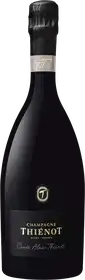
Thiénot in Reims: A Broker's Story, a Thirty-Hectare Vineyard, Stainless Steel Vinification
Twenty Years Selecting Grapes for Others
Champagne Thiénot is an independent, family-owned house in Reims, founded in 1985 by a former grape broker in Champagne. For nearly twenty years, Alain Thiénot travelled the hillsides to select lots for the great centuries-old houses, before creating his own. The bottle was already a family affair: his father had run the Irroy Champagne house, and his grandfather, a glassmaker, made its bottles. Garance and Stanislas Thiénot, his children, now lead the house.
Thirty Hectares Covering More Than Half of the House's Needs
From those years as a broker, Alain Thiénot gained a detailed knowledge of the plots, and then a vineyard of around thirty hectares. The Grand Cru vineyards are located in Aÿ, a land of Pinot Noir in the Grande Vallée de la Marne, as well as in Le Mesnil-sur-Oger and Avize, in the Côte des Blancs. The Premier Cru vineyards extend across Dizy, Cumières and Pierry, complemented by vines in Damery. The rest comes from growers whose supplies Nicolas Uriel has long overseen: he joined Thiénot in 2008 to manage sourcing, and this agronomist and oenologist has been cellar master since 2017.
Temperature-Controlled Stainless Steel from Day One
From the very beginning, Alain Thiénot equipped his production site with temperature-controlled stainless steel tanks, a choice that was far from obvious in the mid-1980s. Controlling the temperature during fermentation preserves the purity of the grape aromas. This is the source of the profile the house sums up in three words: "finesse, fruit and freshness". The wines then age beneath the historic headquarters on rue des Moissons, in two kilometres of cellars.
Origine, Famille, Immersion: A Range Signed Thiénot
Origine, the House Style at Entry Level
The Origine Collection brings together the four cuvées through which the house defines its style. The Thiénot Brut, non-vintage, blends 50% Chardonnay, 40% Pinot Noir and 10% Meunier: peach, pear and orchard fruit, according to the house. The Blanc de Blancs Brut, 100% Chardonnay, gains in precision with its notes of lemon and orange blossom. The Brut Rosé (50% Chardonnay, 35% Pinot Noir, 15% Meunier) focuses on morello cherry and raspberry. Finally, the Vintage is the only vintage-dated cuvée in the collection: in 2015, 60% Pinot Noir, of which 19% Grand Cru and 45% Premier Cru.
Famille, Three First Names for Three Vintage Cuvées
The Famille Collection consists solely of vintage cuvées, made mainly from the house's own vines in Premier Cru and Grand Cru sites. Each cuvée bears a first name and a distinct stance: Stanislas is a Blanc de Blancs, Garance is a Blanc de Noirs, that is, a white wine pressed from black grapes (80% Pinot Noir and 20% Meunier in 2016, 75% of it from Grand Cru).
Alain Thiénot, the founder's cuvée, is produced only in years deemed the most promising, and its blend follows the vintage: 60% Chardonnay in 2008, half Chardonnay and half Pinot Noir in 2012.
Immersion, Forty Years in 5,000 Bottles
For its fortieth anniversary, the house drew from its library three consecutive vintages, 2015, 2016 and 2017, selected by tasting by Nicolas Uriel together with Garance and Stanislas Thiénot. The Immersion series totals 5,000 bottles, including 2,000 for each of the 2016 and 2017 vintages. These are 100% Grand Cru Blanc de Blancs, blended from just two villages in the Côte des Blancs, Cramant and Oger. Each label reproduces a map at a different scale, from the region down to the centre of Reims.
Blanc de Blancs, Pinot Noir, a Gift Cuvée: Comparing Thiénot Champagnes
Blanc de Blancs, Immersion or Stanislas?
The Blanc de Blancs Brut, non-vintage, offers the immediate freshness of Chardonnay. Immersion takes the logic of place further: one vintage, two villages, nothing but Grand Cru. Stanislas, for its part, plays on time more than on origin: the 2011 comes from more than half Grand Cru and Premier Cru fruit, and the house attributes its notes of hazelnut, candied lemon and brioche to age.
Vintage or Garance: Pinot Noir, Blended or on Its Own
The Vintage and Garance Blanc de Noirs both give pride of place to Pinot Noir, but not in the same way. In the Vintage, it dominates a blend in which Chardonnay retains nearly a third. Garance contains no white grapes, and its share of Grand Cru is much higher. The house says it wants to show that great Pinots can combine power and elegance.
As a Gift, the Cuvée That Sums Up the House
The Alain Thiénot cuvée is the safest choice for a gift, as it brings together both grape varieties and the house's crus in an exceptional year. The house presents it as a distillation of its style. For a terroir enthusiast, a bottle of Immersion has the appeal of a limited edition, drawn from the family's library.
Cellaring and Serving: When to Open a Vintage Thiénot Champagne?
Up to Sixteen Years on Lees for the Most Patient
A young house, wines for ageing? In the cellars of rue des Moissons, Thiénot's vintage Champagnes can rest for up to sixteen years sur lattes, that is, lying on their lees before disgorgement. Garance 2012 spent around nine years there. The house's vintage cuvées therefore reach the market already showing some bottle age, ready to be opened.
Comparing Two Vintages of the Same Cuvée
When the selection offers two vintages of the same cuvée, a comparison becomes possible. Opening Garance Blanc de Noirs 2012 and 2016 side by side reveals the effect of the blend as much as that of age: 90% Pinot Noir in 2012, 80% in 2016. The non-vintage cuvées of the Origine Collection, meanwhile, can be enjoyed upon release, as the house blends them to achieve a consistent style from one year to the next.