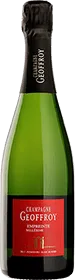
Geoffroy, grower in Cumières: vineyards, Aÿ cellar and winemaking without malolactic fermentation
Eleven hectares in the premier cru of Cumières
Geoffroy Champagnes are born on the right bank of the Marne Valley, in Champagne, where the family has cultivated vines in Cumières since the 17th century. The estate covers 14 hectares spread over 35 plots: around eleven in Cumières, a village classified premier cru, with the remainder in Damery, Hautvillers and Fleury-la-Rivière. The plantings lean towards black grapes, with 42% Pinot Noir, 34% Meunier and 24% Chardonnay. Roger Geoffroy and his wife Julienne produced their first bottles in the early 1950s; their grandson Jean-Baptiste joined the estate in the late 1980s, and his five daughters are preparing the next chapter.
A winery in Aÿ, where the juice flows down by gravity
In 2008, Jean-Baptiste and Karine Geoffroy moved the winemaking to Aÿ, into a house dating from the late 19th century. The grapes are pressed there on two traditional Coquard presses, then the juice reaches the tanks without pumps, by gravity alone. Each plot is vinified separately, in enamel-lined tank, foudre, barrique or demi-muid depending on its potential, and fermentations start with indigenous yeasts. The wines are neither filtered nor fined.
Why malolactic fermentation is avoided
Malolactic fermentation, which Geoffroy avoids, converts crisp malic acid into softer lactic acid. The choice responds to the place: on its south-east-facing slopes above the Marne, Cumières ripens early and is often harvested before the neighbouring villages, yielding rich grapes. Keeping the malic acid preserves the freshness that this ripeness would tend to erase, and this is where the house style comes from: vinous yet precise.
Expression, Pureté, Empreinte, Volupté: what lies behind the names in the Geoffroy range
Expression and Pureté, one blend for two ageing approaches
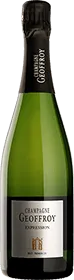
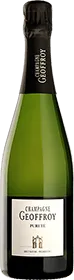
The names in the Geoffroy range reveal nothing of these cellar choices, and Expression, its non-vintage Champagne, offers the first example: 40% Pinot Noir, 35% Meunier and 25% Chardonnay from Cumières, half of which comes from the perpetual reserve begun in the 1970s. Pureté starts from the same blend, but spends 60 months on lees instead of 36 and receives no dosage, making it a brut nature. Expression leans towards stewed apple and a hint of vanilla; Pureté glides towards citrus, green apple and gunflint.
Empreinte, Pinot Noir from three lieux-dits
Empreinte is the estate’s vintage blanc de noirs, 100% Pinot Noir from three lieux-dits in Cumières: Les Chalmonts, Les Barremonts and Les Pêchers. The vines, more than 40 years old, grow mid-slope at around 160 metres, on a 19% gradient, in clay-limestone soil scattered with fragments of meulière stone (a local flint). Only the tête de cuvée is retained, fermented in oak barrels and foudres, and the bottle then spends 72 months on lees. Several vintages feature in the selection, allowing you to compare two years side by side.
Volupté, Chardonnay from the chalks of Cumières
Volupté is Geoffroy’s vintage blanc de blancs, an exception in a vineyard dominated by black grapes. According to the estate, it blends in equal parts two very chalky lieux-dits: Les Chênes, facing south-east, for fruit, and Tourne Midi, facing west, for precision. The 2017 spent more than seven years in the cellar before disgorgement. The only blanc de blancs from the estate in the selection, it is aimed at those who prefer the chalky tension of Chardonnay to the generosity of Pinot Noir.
Les Houtrants Complantés, five grape varieties on a single plot
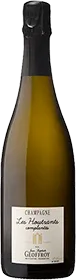
Les Houtrants Complantés is Geoffroy’s single-plot cuvée: in 2004, on his return from a stay in Alsace, Jean-Baptiste Geoffroy replanted this lieu-dit in Cumières as a mixed planting, the oldest form of viticulture, where Pinot Noir, Meunier, Chardonnay, Arbanne and Petit Meslier grow side by side. The sandy, clay soil is not chalky at the surface, and only the deep roots reach the chalk. Produced in very small quantities, the cuvée draws on a reserve specific to the plot, kept in magnums since 2008, then spends 84 months on lees without dosage.
Rosé de Saignée or Blanc de Rose: two macerated rosés from Geoffroy
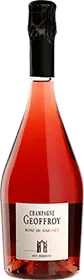
Rosé de Saignée, an infusion of Pinot Noir
Geoffroy’s Rosé de Saignée opens the rosé family with a pure Pinot Noir from Cumières, made from vines selected for the estate’s red Coteaux Champenois. Whole berries macerate cold in a wooden vat, for 78 hours in the latest batch described by the estate, before the free-run juice is drawn off to ferment. The colour comes from contact with the skins, rather than from the addition of red wine, the most common method for rosé Champagnes. Wild strawberry, cherry, blackberry: the wine is designed for the table.
Blanc de Rose: Pinot Noir and Chardonnay macerated together
Created by Jean-Baptiste Geoffroy in 2008, Blanc de Rose applies the saignée method to a blend. Pinot Noir and Chardonnay, in equal parts, macerate together for 60 hours. The grapes come from La Montagne, where the chalk lies just beneath very little soil, and from Les Bellenaux, with its deeper clay-chalk soil. After 84 months on lees and a very low dosage, this extra brut rosé is more taut than its counterpart, with notes of rose, blood orange and grapefruit.
Which Geoffroy Champagne to choose for the aperitif, the table or the cellar
To discover the estate
Expression is the entry point to the range and the cuvée that best conveys the perpetual reserve. With oysters or sea urchins, Pureté goes further in salinity, without a single gram of added sugar.
At the table, the structure of Pinot Noir
Empreinte calls for roast poultry with morels or quail with grapes, pairings suggested by the estate. Rosé de Saignée stands up to a tartare or spicy cuisine, while Blanc de Rose prefers raw fish and citrus fruits.
Cellaring, and understanding the price differences
Volupté, Empreinte and Les Houtrants Complantés spend from 72 to more than 84 months on lees. Their intact malic acidity gives them the means to evolve in the cellar. The price tiers follow this time in the cellar and rarity: first the non-vintage cuvées, then the vintage Champagnes and the two rosés, and finally the single-plot Houtrants.