Nicolas Maillart: three villages on the Montagne de Reims, the break from the cooperative and barrel vinification
Écueil, Villers-Allerand and Bouzy, on either side of the mountain
Based in Écueil, south of Reims, Nicolas Maillart grows his vines in three villages of Champagne. Écueil and Villers-Allerand are classified premier cru, Bouzy grand cru, on the southern slope of the Montagne de Reims. Villers-Allerand accounts for the largest share of the vineyard, and the grape varieties follow the relief: Pinot Noir on the chalky slopes, Meunier on the plateau, Petit Meslier in the coldest corners.
2003, the harvest leaves the village press
Nicolas Maillart took over the family estate in 2003 and stopped taking his grapes to the Écueil cooperative press in order to vinify them himself. The family was already growing vines in 1753 in Chamery, the neighbouring village. To the plots inherited from both sides of his family are added those of his cousins, which he works himself. This is what explains his status as négociant-manipulant.
Barrels for texture, never for oak flavour
All of the estate's wines are born in wood: 228-litre barrels for the lieux-dits, a 3,000-litre foudre as a complement for Platine and Montchenot, and ten months of ageing on the lees. The winemaker says he looks to the barrel for brightness and to the lees for texture, but neither oakiness nor richness. Malolactic fermentation is not sought, dosages remain minimal and the wines are not filtered. Kermit Lynch, his American importer, compares tasting his still base wines to tasting in a cellar of young Burgundies.
Choosing at Nicolas Maillart: the Platine blend, then Pinot Noir, Meunier, grand cru, ungrafted vines or Petit Meslier
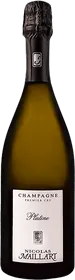
Platine, the blend of the three villages
Platine is the estate's blend, the one exception to this plot-by-plot approach. A non-vintage Brut dosed as Extra Brut, it brings together the three grape varieties from the three villages, led by Pinot Noir, and several harvests: a recent edition was based on four years, from 2014 to 2018. Essi Avellan, Master of Wine, has judged it far superior to its price since its debut. It is the cuvée to start with.
Les Loges, Montchenot, Les Auges: three Pinots Noirs from Villers-Allerand
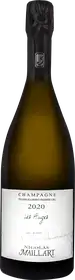
Les Loges, Montchenot and Les Auges are three Blanc de Noirs made from 100% Pinot Noir, born in the same village, yet unlike one another. Montchenot, named after a hamlet of the commune, is the largest of the lieux-dits (3 ha of vines planted between 1969 and 1993). Les Loges comes from 0.73 ha planted in 1966; it is released as a non-vintage Brut Nature, with no added sulphur. Les Auges, vintage-dated and non-dosed, is the most structured of the three.
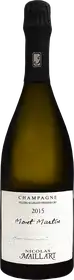
Mont Martin, old-vine Meunier
Mont Martin is a Blanc de Noirs made from 100% Meunier, from 1.8 ha planted in 1972 on clay and sand, in Villers-Allerand. Vinified in barrels, without malolactic fermentation and barely dosed, it shows what this grape variety, often confined to blends, delivers when it is isolated on a plot of old vines.
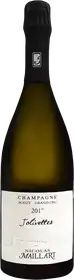
Les Jolivettes, the Bouzy grand cru
Les Jolivettes is the only grand cru in the selection: a Pinot Noir from Bouzy planted in 1987 on 0.6 ha of limestone and chalk, non-dosed. Essi Avellan sees it as arguably the finest lieu-dit of the estate.
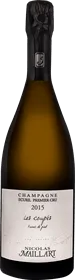
Les Coupés, an ungrafted Pinot Noir
Les Coupés is a plot in Écueil that Michel Maillart, Nicolas's father, replanted in 1973 without American rootstock, on sand that keeps phylloxera at bay. Less than half a hectare (0.45 ha). The cuvée is produced only in good years, which explains the missing vintages in the series.
Les Courzy, a Blanc de Blancs of Petit Meslier
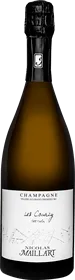
Les Courzy is a pure Petit Meslier, planted in 2015 by massal selection on 0.84 ha of clay and limestone in Villers-Allerand. The 2019 vintage yielded only about 1,700 bottles. Nicolas Maillart is interested in this grape variety for its acidity, which it retains even when picked two weeks after Meunier: an asset in the face of global warming. As a white grape, it naturally makes the cuvée a Blanc de Blancs.
Back label, cellaring, 2020 and 2021 vintages: when to open a Nicolas Maillart champagne
What the back label says
Each bottle bears its disgorgement date and dosage on the back. These two details matter with a winemaker who doses so little: they make it possible to compare two bottles of the same cuvée, whose dosage may change from one edition to the next.
Drink early or cellar
Platine and Mont Martin can be enjoyed from release. Richard Juhlin even recommends drinking Mont Martin young for its generosity, and judged Les Auges, from the same village, better structured for ageing. Les Coupés is the most patient cuvée: the critic Tamlyn Currin extended the drinking window of the 2015 to 2036.
2020 and 2021, two contrasting years
Several lieux-dits exist as vintage champagnes in 2020 and 2021. 2020 saw a hot, dry summer; 2021, a cool year marked by frost and mildew, produced a small harvest